Jiuxun Yin 尹九洵
Research Geophysicist at SLB | Harvard Alumni
Research Interests
I am a seismologist interested in every aspect of earthquakes. Earthquakes can cause large ground motions, damaging manufactured infrastructures and thus greatly threatening human lives. I strive to improve our understanding of earthquake physics using my expertise in earthquake seismology. My research is diverse, including but not limited to seismic observations, numerical simulation, machine learning, and earthquake early warning with innovative techniques such as DAS.
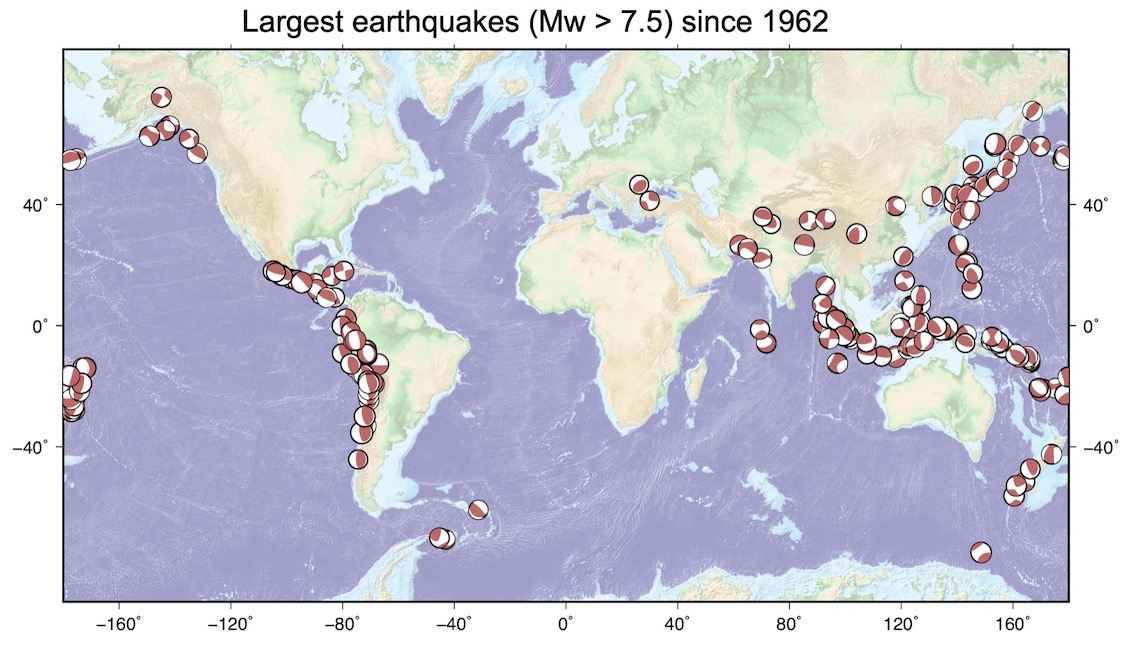
In the recorded history, the largest earthquakes—for instance, the 2004 Sumatra Mw 9.2, the 1960 Great Chilean Mw 9.4, the 1964 Alaskan Mw 9.3, and the 2011 Tohoku Mw 9.0 megathrust earthquakes—have killed many, caused great damage, and brought tremendous financial losses. These earthquakes induce not only strong ground motion but also large tsunami waves.
As populations grow, especially in coastal regions where large earthquakes usually occur, mitigating the earthquake hazards is critical. During large earthquakes, building collapse caused by ground motion—as well as coastal destruction caused by huge tsunami waves—are deadliest to human. Both are directly controlled by the earthquake source and their mitigation requires sufficient knowledge about the physics of the earthquake rupture.
Research Focus
- Earthquake rupture process: Initiation, evolution, and termination of large earthquakes
- Distributed Acoustic Sensing (DAS): Earthquake early warning using fiber-optic cables
- Machine learning in seismology: Seismic signal denoising and separation
My research aims at better interpreting the physics behind a destructive earthquake and helps to mitigate risks of earthquakes. I'm applying innovative techniques in my earthquake studies, including but not limited to using machine learning techniques to denoise the seismograms, using the DAS (Distributed Acoustic Sensing) data recorded by fiber-optical cables for earthquake early warning.
Selected Research Areas
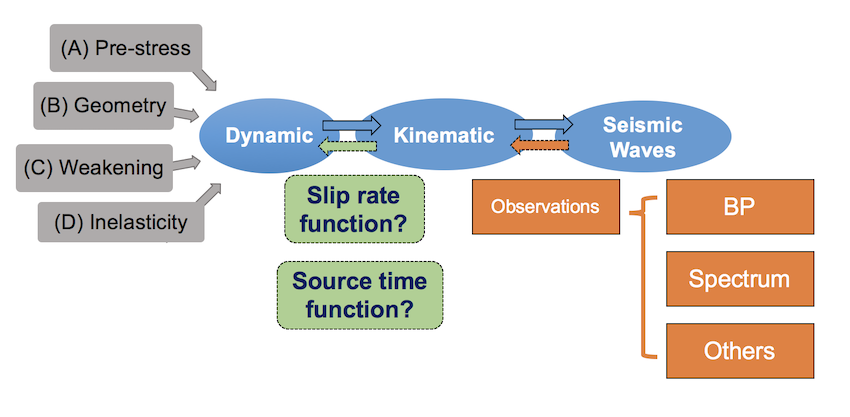
I develop new observational techniques and metrics that are directly relevant to physical models of the source. This includes:
- Observational methods to study earthquake source
- Spatial and temporal evolution of earthquake rupture
- Kinematic and dynamic modeling of earthquake rupture
- Dynamic features in the earthquake source time functions
- Bridge between source observations and source dynamics
DAS for Earthquake Early Warning
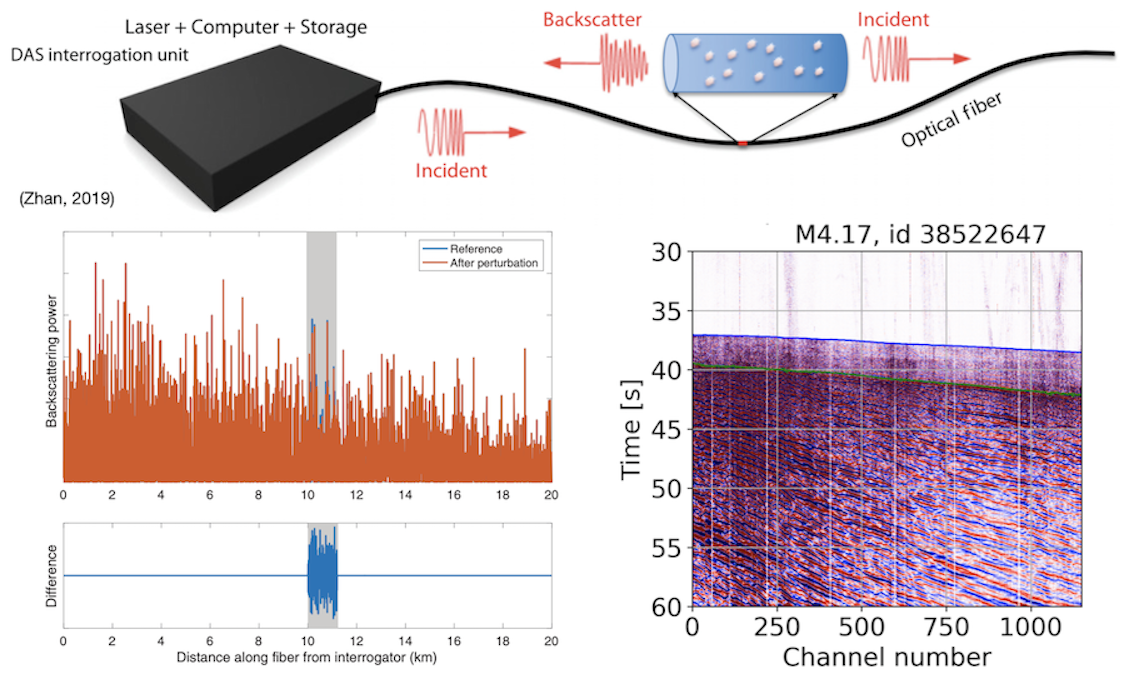
DAS (Distributed Acoustic Sensing) is an emerging technique recently introduced to the geophysical community. This fascinating technique can convert tens of kilometers of telecommunication fiber-optical cables to a dense seismic array with thousands of sensors.